

Just as spectacular, Angkor Thom was built in the 12th century as the capital city of the Khmer empire. The giant faces are breathtakingly beautiful in their serenity.

Just as spectacular, Angkor Thom was built in the 12th century as the capital city of the Khmer empire. The giant faces are breathtakingly beautiful in their serenity.

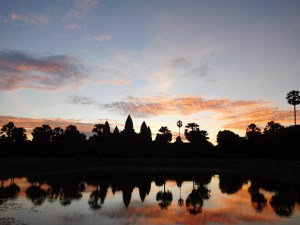
Like the Taj Mahal, it doesn’t disappoint.
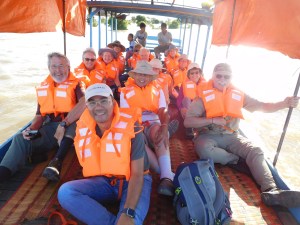 Today was mostly just getting there! The ship started engines at 5 AM and we navigated through the (very) choppy lake of the Tonle Sap until about noon. Amazingly, we tied up at a tree and were met by a small boat. The crew transferred our luggage, we transferred ourselves and then we were off, motoring down a narrow canal to the docking area outside of Siem Reap. There we were met by a bus and finally, after about 45 minutes on the bus, arrived at the Tara Angkor hotel in downtown Siem Reap. After lunch and an hour to settle in, we were off to the Angkor National Museum.
 This museum is relatively new and concentrates on the treasures, history and architecture of Angkor Wat. Very well done with informative write-ups on the displays – and even air-conditioned (the only public building we have been in on this journey that is).
Early bed tonight as we will be at Angkor Wat for the sunrise tomorrow.
 A major portion of this adventure was spent on the Toum Teav, a small ship with 10 cabins (up to 20 passengers) and 14 crew. It’s dining/bar area is open-air and there is a sundeck. The cabins are very small but reasonably comfortable – air conditioned but the doors to the outside are louvered only so open to the air (and to night bugs). However, the bathrooms are more than sufficient with lots of hot
 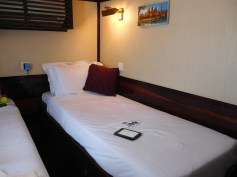 water and a good shower. The staff kept things sparkling clean and everyone well-supplied with bottled water, clean laundry, information, tasty meals and thai-style massage. Although a Viking river cruise is more comfortable, a larger ship could not have navigated the small channels and canals that we did, nor have us transfer to even smaller vessels to dock in tiny villages or explore hidden sights.
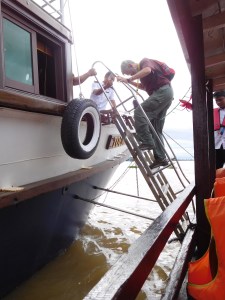 Getting from ship to barge (okay, these were maybe 30 feet by 9 feet with an outboard motor, a driver and a helper, with folding chairs lined up for us) was always an adventure. The small boat would tie up to the prow of the Toum Teav, our crew would lower a small ladder and over we would go – mid-canal, mid-lake, mid-river! No one ended up swimming and we even managed travel on a much smaller boat sitting on the floor and wearing our life jackets. The only hard part was getting up again.
Kudos to the crew of the Toum Teav!
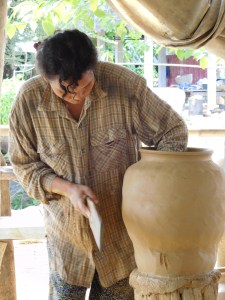 What a fascinating day! We left the Toum Teav early to explore two small family enterprises in Kampong Chhnang village – pottery and palm sugar “factories”. The clay is dug out of the nearby mountain and we visited with a remarkable woman who creates beautiful pots and other items for sale from this clay. The only mechanical help is a fan. She shapes everything by hand – she is the potter’s wheel, circling the lump of clay and shaping it with a flat paddle and her skill. The pieces are dried by the sun and then in a fire, not a kiln. She sells a large pot for $1.15 to the wholesalers. She begins work about 4 AM every day and works until after dark, using a headlamp for light when needed while her husband mines the clay. They consider that they are doing well – there is a bathroom now, a good pump and electricity. The children can go to school She has a roof and ceiling fans in her work area, a beautiful smile and justifiable pride.
The palm sugar “factory” is a young man who harvests the palm liquid from a group of about 30 trees. Every day he climbs every tree 4 times, using a bamboo ladder, squeezes the stalks/fruit for the liquid and dumps the liquid into an enormous wok to be boiled down to palm sugar. His wife manages the sugar-making and packages the product. We met the young man’s mothe r and were given a glimpse into their home – very clean and tidy with large open areas, a separate kitchen shed, hammocks and a television for the nightly soap opera (extremely popular here). Another family proud of their accomplishments. Oh, and I can recommend palm sugar as absolutely delicious!
Afternoon – another barge. This one was MUCH smaller and we had to wear our life jackets while sitting on its floor. We motored through a floating village – all floating houses now, since it is the rainy season. Amazing to see tiny floating shops, restaurants, homes and even pharmacies! We could see the strips that will be roads again in the dry season but now are just part of the canals. Fascinating.
The day ended with the captain’s farewell dinner on our little ship and we said goodbye to the wonderful crew, packed our bags and tried to escape from the huge numbers of bugs here at the edge of the lake. Tomorrow morning we will cross this choppy sea to Siem Reap.
 This was our last morning in Phnom Penh – and that meant a Tuk Tuk tour of the city and a stop at the Central Market. These motorbikes with a three-wheeled “carriage” are a blast to ride in, although we cringed as we dodged between trucks and buses, ignored the center line in streets and blithely drove through red lights. That’s just the way it’s done here. First stop – the train station: this is the first train running again in Cambodia – the tracks are in poor shape due to the wars and the heat. It’s still really slow – apparently driving to a destination takes 4 hours, a bus takes 5 hours and the train takes 8 hours! But the station is very modern with kiosks and electronic notice boards and with Japanese assistance they hope to eventually have fast rail travel nationwide. We returned to our tuk tuks and toured the city, including an area packed with new and continuing construction – mostly Chinese investment. We made a quick stop for gas – about 45 seconds. A “gas station” can be a place on the side of the road with 20 or 30 containers (old coke bottles and water jugs) filled with gas and pouring a liter of diesel into a motorbike only takes a moment!
Last stop was the Central Market, a confusing maze of goods for sale by hundreds, or maybe thousands of local people. There is clothing of every variety, jewelry, souvenirs, food, snacks, household supplies, baskets, paintings, furniture, toilet paper, school uniforms – you can find anything! Getting totally lost is definitely an option. However, we all managed to find our way out, eventually, cross the streets without being hit by motorbikes, bicycles, buses, cars, tuk tuks, or other pedestrians and return to the Toum Teav.
After cruising several hours, we arrived in Kampong Tralach. After the usual transfer from our small ship to a small barge, we pulled up to the pier (a tree to which the barge was tied) and saw our next excursion – ox carts. Hmmm. The oxen were calm, the drivers friendly and the fleas were few, but I can’t recommend oxcart for the fragile of bone or kidney! It’s a bit. . . . .bumpy, but we arrived at the Kampong Tralach Leu pagoda more or less whole. This old but off the beaten path pagoda is lovely and surrounded by small children trying to sell us drawings and lotus blossoms. Inside the pagoda, we viewed beautiful wall paintings and had a blessing from the Buddhist monk there. Escaping the children, we returned to our oxcarts and then to our barge and then to our ship.
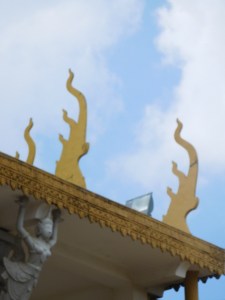 All I can say about the Palace is – wow! There are a number of buildings with the beautiful Cambodian rooftops dragon emblems. Royal clothing is on display, The Silver Pagoda is aptly named – the entire floor is solid silver tiles. The images of Buddha are gold with diamonds, or jade, or just gold. We wandered through the complex (melting in the heat) but enjoyed exploring the temples and other buildings.
A short visit to the National History Museum introduced us to Khmer history and the type of artifacts we will see at Angkor Wat.
Lunch was at the popular Titanic Restaurant – complete with Apsara dancer and traditional music.
We had our own Apsara dancers on board our ship after dinner, performed by the children from a local orphanage who are learning this almost-forgotten art form. My hands definitely do not bend that way!
 The day began with a lecture on the history of Cambodia from a French journalist who has lived here almost 20 years.
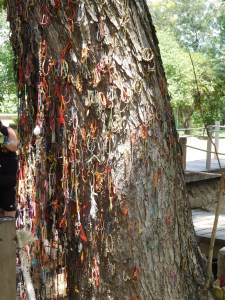
The visit to the Choeung Ek Killing Fields was difficult and disturbing. The genocide of the Cambodian people by the Khmer Rouge in the 1970’s is horrifying yet I knew almost nothing about it. Why? Politics, of course. The Khmer Rouge were welcomed to Phnom Penh as liberators and then drove everyone from the city, tortured and executed hundreds of thousands, forced hundreds of thousands more into slavery and “re-education camps,” brainwashed children to torture and murder anyone they labeled as a dissident, CIA or Vietcong, and starved to death many thousands more. Perhaps 3 million died– perhaps 2 million – the numbers cannot be easily calculated. The Killing Fields are the site of the mass graves and executions – now are a memorial. Forty-three of the mass graves have been excavated to provide proof of the crimes against humanity but the rest in this area (almost 100 more) are left untouched. There is a tree where infants where killed – it is covered now with prayer bracelets.
S-21 (Tuol Sleng) is the interrogation center where prisoners were tortured and forced to confess their “crimes”. The shackles are still present, along with pictures of hundreds of the victims, complete with their identifying numbers. We had a local man, Pun, as guide for the day. He lost his father and two brothers to the Khmer Rouge – it seems no Cambodian today is untouched by the horror of the 4 year occupation.
In spite of this terrible period, today Cambodia is surging – there is a lot of investment from the Chinese, Malaysia, Japan and Singapore and a great influx of Chinese to build and secure their business here. All those we’ve talked with have said that the past 10 years have seen a real uptick in the standard of living for many Cambodians. Make no mistake, this is still a poor country, but there is a lot of justifiable pride in what they are accomplishing now.
 The day began with a visit to a local fish farm – tilapia, I think. The method here is interesting – there is a fish … cage I guess it can be called … of timbers or bamboo with net in between. The cage is about 30 feet square and there can be a building on top! The cage can float or sink as needed and is remarkably effective. We saw the farmer feeding the fish and trust me, this is what a feeding frenzy looks like – yikes.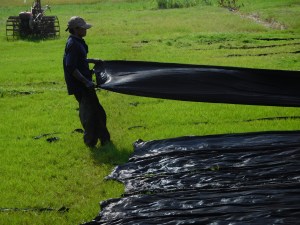
The next adventure involved a bicycle rickshaw ride through a small town. These rickshaws are for only one passenger and that passenger needs to have a decent sense of balance, but it was great to see the town at a slow pace. We stopped at a silk weaving factory – family-owned and weaving simply beautiful fabric. It was fascinating watching these old machines weave in patterns and the factory workers’ sharp eyes and skilled hands smoothing and untangling tiny knots in the nearly-invisible silk threads. We walked a bit to another factory that specializes in a traditional silk-dying method that creates an extremely shiny black silk, using only a local berry as the dye. The fabric is dipped, squeezed and spread on the grass to dry – and the process is repeated 100 times – that’s one zero zero. The results are simply beautiful. The family has also started experimenting with other colors using all-natural local dyes.
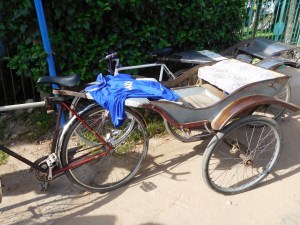 A return rickshaw ride and we were back on the boat, ready for departure to Cambodia (that’s Campochea here).
After sitting at the border (an invisible line in the middle of the river), we were finally able to continue on toward Phnom Penh. We also viewed the film, The Killing Fields to give us a little context about the role of the Khmer Rouge in Cambodian history.
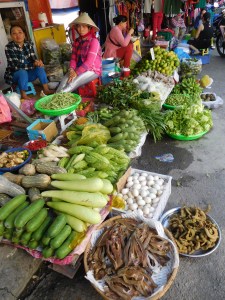 My favorite things in one day! First, a visit to an enormous food market, with every kind of fish/seafood and then every kind of fruit and vegetable. Really fun! First, all the fish are still alive, including the eels and yes, the frogs. Shrimp actually jumped out of their container. We walked past baskets of snails and cockles, moved on to tables of every part of the pig, saw some very dispirited chickens (they knew their time had come), and perused the wares of dozens of vendors of vegetables and fruits. We even saw one of kitchen staff from our boat buying custard apples and snakehead fish.
We traveled next to the Lovers’ House, which is the site of an unrequited love affair between a Chinese man and a Vietnamese woman – apparently considered very romantic.
We went off to a beautiful plant nursery afterwards and enjoyed walking among the thousands of plants and flowers.
After returning to the boat, we began the cruise to Phnom Penh.
 journeys